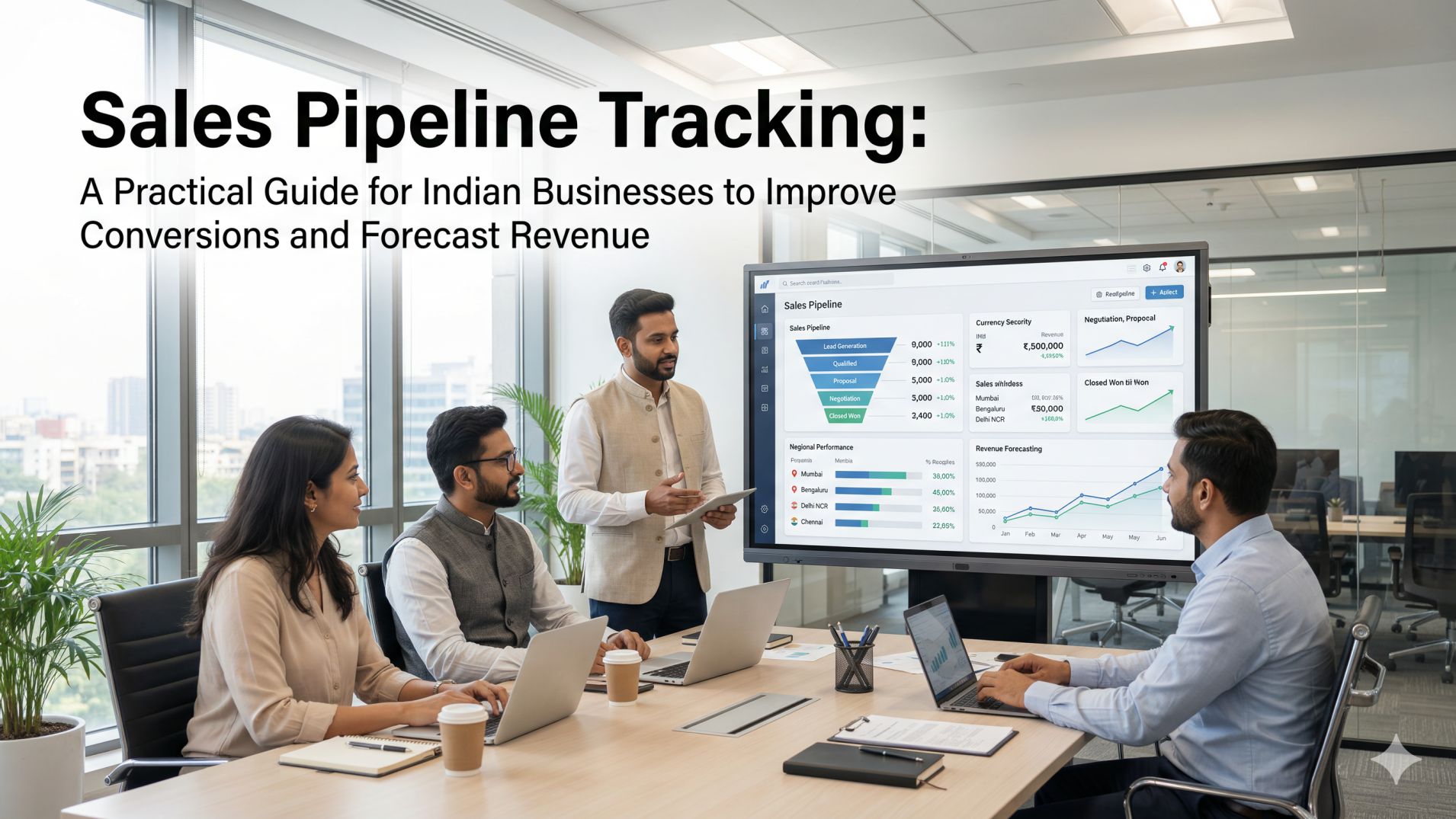
Every sales team in India, from a Noida software reseller to a Pune manufacturing distributor, faces the same quiet problem: leads enter the funnel with enthusiasm, yet nobody can say with confidence where deals stall or why. Sales pipeline tracking solves this. It means recording every opportunity, moving it through clearly defined stages, and measuring what happens at each step, so decisions rest on evidence instead of gut feeling. Fount Mart, a sales consulting firm based in Noida, builds its pipeline management service on this idea, and the guidance below combines its publicly described approach with widely accepted sales practice.
What Sales Pipeline Tracking Really Means and Why Indian Sales Teams Can No Longer Ignore It
A pipeline is a visual and numerical map of your revenue journey. Each prospect sits at a specific stage, each stage has an expected conversion rate, and each deal carries a value and a probable closing date. Sales pipeline tracking is the routine of keeping that map accurate and reviewing it often enough to act on what it reveals.
In the Indian market this matters even more. Buying cycles are often longer because multiple decision makers, price negotiations, and approval layers are common. Teams also handle leads from referrals, marketplaces, channel partners, exhibitions, and WhatsApp. Without a disciplined view, promising opportunities slip through the gaps. Fount Mart notes on its website that measuring metrics across the sales funnel helps identify and fix weak points, which is exactly the problem a tracked pipeline is designed to expose.
The Core Stages Every Pipeline Should Define Before You Start Measuring Anything
Sales pipeline tracking is only as reliable as the stages it is built on. If two salespeople interpret “qualified” differently, your numbers will mislead you no matter how good your dashboard looks. Before any measurement begins, agree on stage names and entry rules, and write them down for everyone. A typical B2B structure includes the following:
- Lead capture: a new enquiry or prospect is recorded with its source, so you can later see which channels deliver buyers rather than browsers.
- Qualification: the prospect is checked for budget, authority, need, and timeline. This stage protects your team’s time by filtering out enquiries that will never convert.
- Proposal: a tailored quotation or solution is shared. Recording the offered value lets you compare it with the final deal.
- Negotiation: commercial and contractual terms are discussed. In India this often involves credit periods and GST considerations, so noting objections at this point is valuable learning.
- Closed won or lost: the outcome is recorded along with a reason. Lost reasons are the most underused data in most companies, yet they show exactly where the process needs work.
Metrics That Make Sales Pipeline Tracking Useful Rather Than Just Busy
Collecting data is easy; choosing what to watch is the real skill. Too many indicators create noise, while too few leave blind spots. Sales leaders commonly find that a small set of metrics reviewed consistently beats a sprawling report nobody reads. Consider starting with these:
- Stage-to-stage conversion rate: this shows the percentage of deals that advance from one stage to the next. A sharp drop between proposal and negotiation, for example, usually points to pricing or positioning issues rather than lead quality.
- Average sales cycle length: this measures how many days a deal takes from first contact to closure. A lengthening cycle signals friction worth investigating early.
- Pipeline coverage: this compares the total value of open opportunities against your target. Many sales leaders look for coverage of roughly three times the target, though the right multiple depends on your own conversion history.
- Lead response time: this records how quickly a new enquiry receives a first meaningful reply. Fast follow-up consistently improves the chance of conversion.
- Win rate by source: this reveals which channels produce customers who actually buy, helping you place budget where it earns returns.
Strong sales pipeline tracking links these numbers together, so a change in one metric prompts a specific question about another.
How Fount Mart Approaches Pipeline Management for Growing Businesses
Fount Mart positions itself as a sales consulting partner rather than a software vendor, and its offering covers strategy consulting, brand building, sales pipeline management, and sales enablement. According to its website, the team includes a dedicated pre-sales group, monitors each stage of the pipeline, and customises solutions to fill gaps in a client’s existing process. It also states that it aims to supply a steady flow of qualified leads and that leads are exclusive to a client within their category. The company was founded by Sandeep Singh and Mohit Gauba, who are described as having sales and business management backgrounds.
This human-led model suits many Indian companies that already own a CRM but struggle with sales pipeline tracking. Software records activity, yet it cannot decide which stages need redesign or coach a team through a weak conversion step. Advisory support fills that gap. If you are evaluating any provider, including Fount Mart, ask for named case studies and measurable results during your conversation, since evidence of past outcomes is the fairest way to judge expertise.
Common Mistakes Indian Businesses Make and Practical Ways to Avoid Them
Many organisations believe they are doing sales pipeline tracking when they are really maintaining scattered notes. The following problems appear repeatedly:
- Data lives in personal spreadsheets and chat threads: when a salesperson leaves, their deals leave with them. A shared system, even a simple one, keeps knowledge inside the company.
- Stages are vague or inflated: reps move deals forward optimistically to look productive, which makes forecasts unreliable. Clear exit criteria for every stage remove this temptation.
- Stale deals are never cleaned: opportunities untouched for months distort coverage and conversion figures. A monthly clean-up, where each stale deal is either revived or closed as lost, restores accuracy.
- Channel partners are invisible: distributors and resellers often generate a large share of revenue yet sit outside reporting. Including them in your tracking gives a complete picture of demand.
A Simple Thirty-Day Plan to Put Your Process in Place
You do not need a large budget to begin. In week one, document your stages and entry rules. In week two, move all active opportunities into one shared tool. In week three, choose three to five metrics and owners. In week four, hold your first review meeting. Repeat this every week, because rhythm matters more than sophistication.
Building Trust in Your Numbers Through Data Quality, Accountability, and Regular Reviews
Reliable sales pipeline tracking depends on trust. Leaders trust the numbers only when the team enters data honestly and consistently, and the team enters data honestly only when reviews are used for coaching rather than blame. Make one person accountable for data quality, audit a sample of records each month, and celebrate accurate reporting as much as closed deals. Over time, a clean pipeline makes forecasts dependable.
If your business wants expert help designing stages, monitoring conversions, or strengthening lead flow, Fount Mart is based at Let’s Connect Business Park, Sector 136, Noida, and can be reached through fountmart.com. Whichever route you choose, commit to sales pipeline tracking as a daily habit.