Ending a marriage is never an easy decision, but when both spouses agree that separation is the right path forward, the law offers a far simpler route than a long courtroom battle. The mutual divorce process in India allows a husband and wife to part ways amicably, without blaming each other or dragging the matter through years of litigation. At Family Law Chamber, we have guided hundreds of couples through this sensitive journey, and we have seen first-hand how understanding each stage in advance can make the mutual divorce process in India far less stressful. This blog walks you through everything you need to know, from eligibility and documentation to timelines and the real benefits of choosing this route.
What Is Mutual Divorce Under Indian Law
A mutual divorce, often called divorce by mutual consent, is a legal dissolution of marriage where both husband and wife agree that their marriage has broken down irretrievably and jointly petition the court to end it. Unlike a contested divorce, where one spouse accuses the other of cruelty, desertion or adultery, the mutual divorce process in India is built on cooperation rather than conflict. It is governed primarily by Section 13B of the Hindu Marriage Act, 1955, for Hindus, and by corresponding provisions under the Special Marriage Act, 1954, the Indian Divorce Act for Christians, and the Parsi Marriage and Divorce Act, depending on the couple’s religion and the law under which they were married. Because both parties are on the same page about ending the marriage, courts across India tend to treat these petitions far more efficiently than contested ones.
Legal Grounds and Eligibility Requirements
Before a couple can begin the mutual divorce process in India, certain conditions must be satisfied. First, the spouses must have been living separately for a period of at least one year, meaning they are no longer cohabiting as husband and wife, even if they happen to reside under the same roof. Second, both parties must agree that they have been unable to live together and that the marriage has irretrievably broken down. Third, and most importantly, the consent of both spouses must be free, voluntary and not obtained through fraud, coercion or undue pressure. Courts examine this consent carefully, and if either party later claims that their agreement was forced, the petition can be dismissed. Advocate Pooja Makhija Wahal at Family Law Chamber always advises clients to be completely certain of their decision before filing, since clarity at this stage prevents complications later.
Step-by-Step Mutual Divorce Process in India
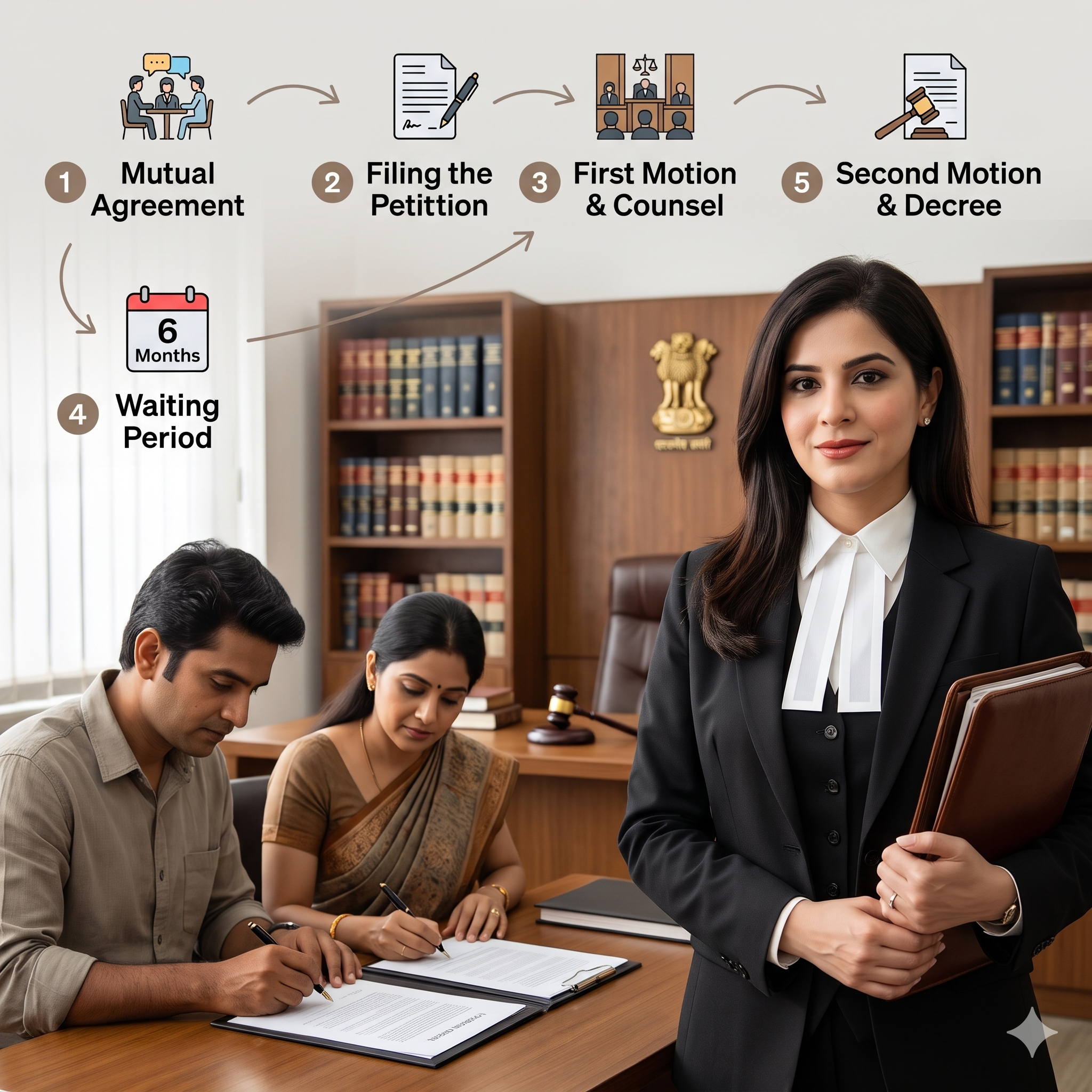
Understanding each stage of the mutual divorce process in India helps couples feel prepared rather than anxious. While the exact procedure can vary slightly by state and court, the broad stages remain consistent across the country.
- Filing the joint petition: Both spouses, through their advocates, draft and file a joint petition before the family court, along with an agreed settlement regarding alimony, child custody and division of property, if applicable.
- First motion: The court records the statements of both parties confirming that they are seeking divorce by mutual consent and that their consent is voluntary. The court then grants an order for the first motion.
- Cooling-off period: After the first motion, the law provides for a waiting period, typically six months, intended to give couples a final opportunity to reconsider.
- Second motion and final hearing: Once the cooling-off period ends, and if neither party has withdrawn consent, both spouses appear again before the court to record their final statements.
- Decree of divorce: Satisfied that all conditions are met, the court passes the final decree, legally dissolving the marriage.
Family Law Chamber handles every stage of this process on behalf of clients, ensuring paperwork is accurate, hearings are attended on schedule, and settlement terms are fair to both sides.
Documents Required for Mutual Divorce
Proper documentation keeps the mutual divorce process in India moving smoothly and avoids unnecessary delays at court. Couples typically need their marriage certificate, proof of address for both spouses, passport-size photographs, income tax returns or salary details for the past few years, evidence of separation such as a settlement deed, and details of any children, including custody arrangements if applicable. If property or assets are involved, documentation related to ownership and the agreed division must also be submitted. Family Law Chamber assists clients in compiling and verifying this paperwork well in advance, which significantly reduces the chances of procedural objections once the petition reaches the family court.
Timeline and the Cooling-Off Period
One of the most common questions couples ask is how long the mutual divorce process in India actually takes. On paper, the law prescribes a minimum cooling-off period of six months between the first and second motions, though courts have the discretion to waive this waiting period in genuine cases where reconciliation seems impossible and the couple has already been living apart for a substantial time. In practice, most mutual divorce cases conclude within six to eighteen months, depending on the court’s workload and how promptly both parties cooperate. Delays most often arise from incomplete documents or disagreements over settlement terms, which is why experienced legal guidance makes such a meaningful difference in keeping the timeline predictable.
Benefits of Mutual Divorce Over a Contested Divorce
Choosing the mutual divorce process in India over a contested one offers several real advantages. It is considerably faster, since there is no need to prove fault or cross-examine witnesses. It is also far less expensive, both emotionally and financially, because the adversarial back-and-forth of a contested case simply does not exist. Privacy is better preserved too, as fewer personal details need to be aired in open court. Perhaps most importantly, when children are involved, a mutual divorce allows parents to jointly decide on custody and visitation in a way that protects the child’s wellbeing, rather than leaving such sensitive matters to a judge’s ruling after a prolonged dispute.
Why Choose Family Law Chamber for Your Mutual Divorce
Navigating the mutual divorce process in India without experienced legal support can quickly turn a simple matter into a stressful one, which is why so many couples across the country trust Family Law Chamber to guide them from the first consultation to the final decree. Led by Advocate Pooja Makhija Wahal, the firm has built a reputation as a trusted name in family law, known for handling every case with sensitivity, discretion and a deep understanding of matrimonial law. Advocate Pooja Makhija Wahal and her team take the time to explain each step clearly, draft airtight settlement agreements, represent clients at every hearing, and work diligently to resolve matters as quickly as the law allows. Whether the case is straightforward or involves complex questions around custody or assets, Family Law Chamber remains a dependable partner throughout the mutual divorce process in India.
Conclusion
The mutual divorce process in India, when approached with clarity, cooperation and the right legal guidance, can bring closure without unnecessary bitterness or delay. From meeting the eligibility conditions to filing the joint petition, observing the cooling-off period, and finally receiving the decree, each step has a clear purpose designed to protect both parties while respecting their shared decision to part ways. If you are considering this path, reaching out to a trusted firm like Family Law Chamber, under the guidance of Advocate Pooja Makhija Wahal, can make the entire mutual divorce process in India smoother, faster and far less overwhelming.