Modern buildings rely heavily on curtain wall systems to deliver structural integrity, energy efficiency, and architectural appeal. However, the performance of these systems must be verified through rigorous testing and inspection processes. Among the many standards available worldwide, aama 501.2 has emerged as one of the most trusted field testing methods for evaluating air and water infiltration in installed curtain wall assemblies.
With increasing demand for high-rise developments and complex façades across the Middle East, developers, consultants, and contractors are paying closer attention to façade testing protocols. Organizations like Cornerstone Middle East play a vital role in ensuring curtain wall systems comply with recognized standards, helping projects meet safety, durability, and regulatory expectations.
This article provides a detailed comparison of aama 501.2 and other curtain wall standards, explaining how each functions within professional testing and inspection frameworks and why selecting the right standard matters for long-term building performance.
Understanding Curtain Wall Performance Testing
Curtain walls serve as the building envelope, protecting interior spaces from weather, pressure changes, and environmental exposure. Any weakness in design or installation can lead to water leakage, air infiltration, or structural deterioration. This makes performance testing a critical phase in construction quality assurance.
Curtain wall testing typically focuses on air leakage, water penetration, structural movement, and resistance to wind-driven rain. These assessments may be carried out in laboratories before installation or onsite after construction. Field testing is particularly important because it evaluates the actual installed conditions rather than idealized samples.
This is where aama 501.2 stands apart it is specifically designed for onsite evaluation of curtain wall systems. Professional testing providers such as Cornerstone Middle East use this standard to identify installation defects early, helping stakeholders avoid costly remediation later.
What Is AAMA 501.2?
AAMA 501.2 is a field test method developed by the American Architectural Manufacturers Association (AAMA) to evaluate air infiltration and water penetration of installed curtain walls, storefronts, and window systems. Unlike laboratory tests, this standard simulates real-world conditions on completed buildings.
The procedure involves applying calibrated air pressure differentials while spraying water across the exterior surface. The goal is to determine whether the system can resist wind-driven rain without allowing moisture to enter interior spaces.
One of the defining strengths of aama 501.2 is its practicality. It helps inspectors pinpoint exact leakage locations, making it an invaluable diagnostic tool during commissioning or post-installation reviews. Testing specialists at Cornerstone Middle East routinely apply this method to support façade acceptance, dispute resolution, and preventive maintenance programs.
Why AAMA 501.2 Is Widely Trusted in the Construction Industry
The popularity of aama 501.2 comes from its ability to replicate actual site conditions. Buildings are rarely exposed to uniform pressures in real life, and this standard accounts for that variability by allowing project-specific test pressures.
Another key advantage is its adaptability. The test can be performed on localized areas rather than entire façades, enabling targeted inspections without disrupting ongoing construction activities. This flexibility makes aama 501.2 especially suitable for large commercial developments and high-rise towers.
Moreover, the standard provides immediate visual confirmation of leakage points. For consultants and testing firms like Cornerstone Middle East, this allows clear documentation and actionable reporting, ensuring contractors can correct deficiencies efficiently.
Overview of Other Curtain Wall Standards
While aama 501.2 is highly regarded for field testing, several other standards are commonly referenced in façade performance evaluations. Each serves a different purpose within the broader testing and inspection ecosystem.
ASTM E1105
ASTM E1105 is another field water penetration test, often compared with aama 501.2. However, ASTM E1105 focuses primarily on static water spray combined with air pressure. It lacks the dynamic, diagnostic nature of aama 501.2, making it less effective for identifying specific leakage pathways.
ASTM E283 and ASTM E331
These standards are typically used in laboratory environments. ASTM E283 measures air infiltration, while ASTM E331 evaluates water penetration resistance under controlled conditions. Although useful during product development, they do not account for real-world installation variables, which aama 501.2 directly addresses.
EN Standards (Europe)
European curtain wall testing often follows EN 12155 and EN 12154 for air and water performance. These laboratory-based methods provide valuable benchmarks but do not replace onsite testing methods like aama 501.2, especially in regions with extreme climates.
ISO Façade Testing Protocols
ISO standards provide general frameworks for building envelope performance. However, they tend to be broader in scope and less detailed when it comes to practical field diagnostics, which is why many Middle Eastern projects still rely on aama 501.2 for site verification.
Key Differences Between AAMA 501.2 and Other Standards
The most significant distinction is that aama 501.2 is a field diagnostic test, whereas many other standards are laboratory-based performance evaluations. This means aama 501.2 assesses real installations rather than theoretical assemblies.
Another difference lies in flexibility. aama 501.2 allows testing at customized pressures, reflecting actual wind loads for specific buildings. Other standards often prescribe fixed pressures, which may not represent site conditions accurately.
Additionally, aama 501.2 emphasizes investigative testing. It helps identify workmanship issues such as poorly sealed joints, misaligned panels, or defective gaskets problems that lab tests cannot detect once systems are installed.
Professionals at Cornerstone Middle East leverage these advantages to deliver precise façade assessments that support compliance, safety, and long-term durability.
The Role of AAMA 501.2 in Testing and Inspection Programs
Comprehensive façade testing programs usually involve multiple stages: design review, material inspection, installation checks, and performance testing. aama 501.2 fits squarely into the final phase, verifying that the completed system performs as intended.
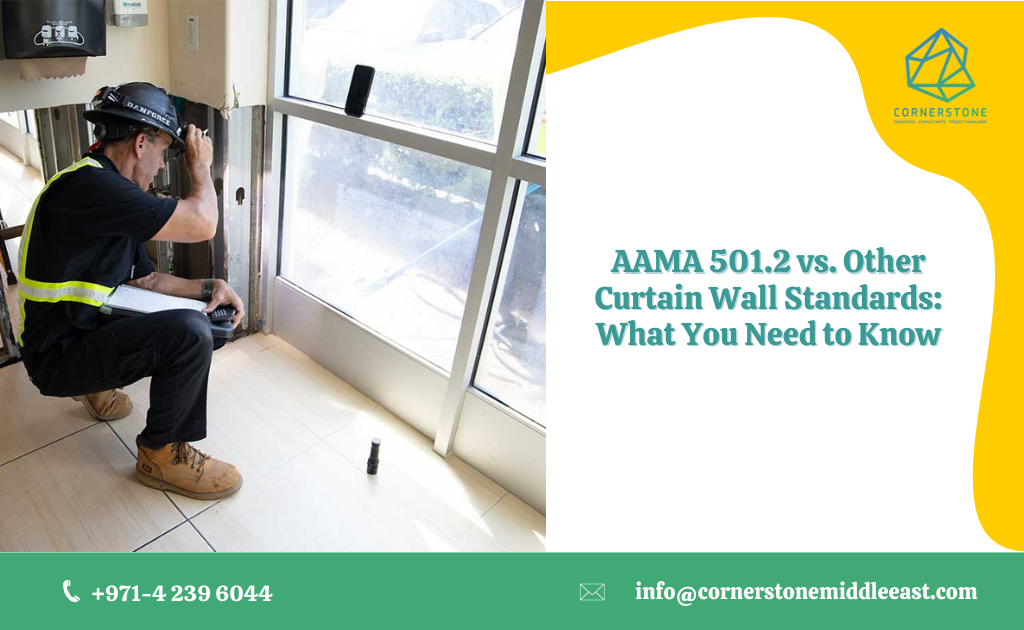
During inspections, trained technicians set up pressure chambers and calibrated spray racks. Water is applied uniformly while air pressure simulates wind forces. Any water ingress is carefully recorded, photographed, and mapped for corrective action.
This process is particularly valuable for high-rise buildings, where even minor leaks can escalate into major structural or aesthetic issues. By incorporating aama 501.2 into commissioning protocols, companies like Cornerstone Middle East help project teams achieve higher quality outcomes.
Why Middle East Projects Rely on AAMA 501.2
The Middle East presents unique environmental challenges, including high wind loads, extreme heat, and occasional heavy rainfall. Curtain wall systems must withstand these conditions while maintaining indoor comfort and energy efficiency.
Because aama 501.2 allows customized pressure settings, it aligns well with regional design requirements. Developers and consultants appreciate its ability to simulate realistic storm conditions, making it a preferred choice for façade validation.
Cornerstone Middle East has extensive experience applying aama 501.2 across commercial towers, residential complexes, and mixed-use developments, helping clients meet international quality benchmarks while adhering to local regulations.
Integration with Broader Building Envelope Inspections
Curtain wall testing should never occur in isolation. Effective inspection programs also include visual surveys, sealant evaluations, anchor checks, and thermal assessments. aama 501.2 complements these activities by providing measurable performance data.
When combined with infrared thermography or adhesion testing, aama 501.2 delivers a holistic view of façade health. This integrated approach enables early detection of hidden defects, reducing maintenance costs and extending system lifespan.
Testing specialists at Cornerstone Middle East often recommend periodic aama 501.2 evaluations as part of preventive maintenance strategies, especially for aging buildings or properties exposed to harsh climates.
Common Issues Identified Through AAMA 501.2
Field testing frequently reveals problems such as incomplete sealant application, damaged membranes, improper drainage paths, or installation tolerances exceeding design limits. These issues may not be visible during routine inspections but become apparent under pressurized water testing.
Because aama 501.2 pinpoints exact failure locations, remediation efforts can be focused and efficient. Contractors can address specific defects rather than undertaking costly, large-scale repairs.
This diagnostic capability is one reason Cornerstone Middle East recommends aama 501.2 during both initial commissioning and post-renovation verification.
Selecting the Right Standard for Your Project
Choosing between aama 501.2 and other curtain wall standards depends on project stage and objectives. Laboratory tests are ideal during design development, while field tests like aama 501.2 are essential once systems are installed.
For projects aiming to achieve high-quality façade performance, a combination of standards is often most effective. However, when real-world validation is required, aama 501.2 remains unmatched in its ability to assess actual construction outcomes.
Consulting experienced providers such as Cornerstone Middle East ensures the appropriate testing protocols are applied at the right time, minimizing risks and protecting investments.
The Value of Professional Testing Partners
Façade testing requires specialized equipment, trained personnel, and detailed reporting. Partnering with an established inspection firm ensures results are reliable and actionable.
Cornerstone Middle East delivers comprehensive curtain wall testing services, including aama 501.2, supported by expert engineers and internationally recognized procedures. Their systematic approach helps clients navigate compliance requirements while maintaining the highest construction standards.
Final Thoughts
Curtain wall systems are a defining feature of modern architecture, but their performance must be validated through rigorous testing and inspection. While many standards exist, aama 501.2 stands out as a practical, field-based method that evaluates real installations under realistic conditions.
By comparing aama 501.2 with other curtain wall standards, it becomes clear that each serves a specific purpose but none offer the same diagnostic precision for onsite verification. Integrating aama 501.2 into building envelope testing programs provides confidence in system integrity, occupant comfort, and long-term durability.
With experienced providers like Cornerstone Middle East, project stakeholders gain access to reliable façade assessments that support quality assurance from construction through operation. In an era where building performance matters more than ever, adopting proven testing methods such as aama 501.2 is not just best practice, it’s essential.