Parametric architecture is one of the most influential movements in modern design, merging computational modeling with creative freedom. It allows architects to create fluid, non-repetitive forms that were once impossible with traditional methods. These complex geometries, seen in museums, high-rises, airports, and cultural centers, are largely realized through intricate curtain wall systems.
However, while parametric façades are visually striking, their functionality cannot be compromised. They must endure high wind loads, resist water penetration, manage thermal movement, and remain structurally stable. Achieving all this requires one crucial process: curtain wall testing.
In this comprehensive blog, we explore how curtain wall testing supports the technical and aesthetic execution of parametric façades, ensures code compliance, guarantees occupant safety, and drives innovation without compromising performance. This is especially critical for developers and design teams working with specialized façade engineering and testing firms like Cornerstone Middle East, who bring in-depth knowledge and advanced testing capabilities to every unique project.
Understanding Parametric Design and Curtain Walls
Parametric design uses algorithms and digital tools to define building geometry. Unlike conventional façades—where identical modules are repeated—parametric façades feature complex curvatures, double-curved glass panels, and non-linear patterns. Every unit or panel might be different in dimension, angle, or radius, meaning there are thousands of unique components forming one building skin.
To deliver this complexity, architects often rely on curtain wall systems—non-structural cladding elements supported by the building frame. They are lightweight and allow for materials like glass, aluminum, steel, and composite panels to be installed externally.
But this diversity in panel shapes and materials introduces new risks:
- Irregular stress distributions due to non-uniform geometry
- Unique connection details for each unit
- Non-traditional movement and load paths
- Potential for misalignment and leakage
Thus, curtain wall testing becomes essential to verify whether these complex systems will perform reliably in real-world conditions.
Why Curtain Wall Testing is Critical in Parametric Designs
- Unpredictable Load Behavior: In parametric façades, each panel can experience different wind pressures depending on its location and orientation. Testing ensures the panels and anchoring systems can withstand dynamic loads without structural failure.
- Complex Joints and Sealants: Non-linear panels mean complex joint patterns. Testing verifies that sealants can accommodate movement and remain watertight over time.
- Material Compatibility: Parametric façades often blend materials like ETFE, curved glass, metal fins, and integrated solar panels. Testing ensures thermal expansion, movement, and bonding behavior do not lead to degradation or failure.
- Installation Variability: No two components may be the same. Field testing helps assess whether actual installation matches lab-tested performance, especially where tolerance is minimal.
Without robust curtain wall testing, even the most beautiful parametric façade could fail due to poor drainage, deflection, seal failure, or structural fatigue.
Key Curtain Wall Testing Methods for Parametric Façades
The following testing procedures are mandatory in evaluating both the design intent and the real-world performance of innovative façades:
1. Air Infiltration Testing (ASTM E283)
Tests the rate at which air penetrates the curtain wall under pressure. Parametric façades, with their variable joints and unique connections, may suffer from uneven pressure zones. This test identifies leak-prone areas, enabling better sealing strategies.
2. Static and Dynamic Water Penetration Testing (ASTM E331, AAMA 501.1)
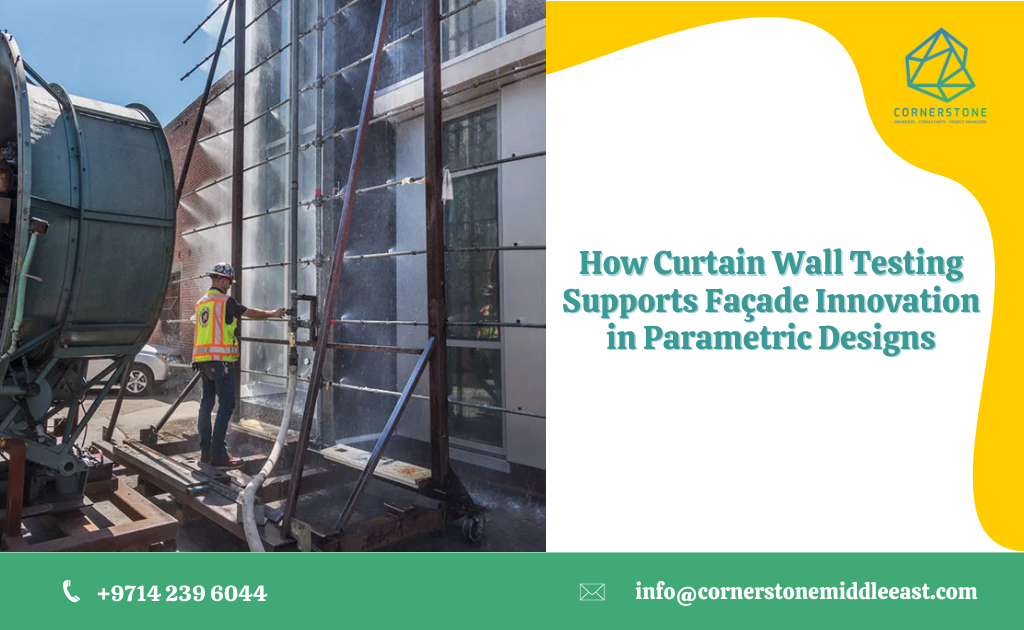
Simulates wind-driven rain using high-pressure water jets. Parametric geometries, especially those curving outward, collect water differently. Testing ensures the water management system works across the full surface.
3. Structural Load Testing (ASTM E330)
Applies positive and negative pressure to evaluate the system’s deflection, strength, and anchorage. Essential for tall parametric façades where panels face varying wind intensities.
4. Seismic Movement and Drift Testing (AAMA 501.4, 501.6)
In buildings located in seismic zones, testing evaluates whether the curtain wall can tolerate lateral drift or inter-story movement without breaking glass, damaging seals, or dislodging anchors.
5. Thermal Cycling and Dew Point Testing
Repeated hot and cold temperature exposure helps identify thermal bridging, condensation points, or seal failure caused by expansion and contraction. Important for façades with glass-metal interfaces.
6. Impact and Safety Glazing Testing (ASTM E1996, E1886)
In regions prone to storms or high-security requirements, impact resistance tests simulate debris striking the façade. Non-standard angles and inclined surfaces in parametric façades require special attention to rebound and breakage patterns.
7. Mock-Up Testing and On-Site Water Spray Testing (AAMA 501.2)
Full-scale mock-up assemblies are tested in labs to simulate real-world scenarios before installation. On-site testing ensures that construction matches mock-up performance.
At Cornerstone Middle East, these test protocols are customized to fit the complexity of each project. Their testing laboratories and field teams are equipped to manage every type of façade—from standard to the most complex parametric geometries.
The Testing Process: From Design to Execution
Curtain wall testing is not a one-time event. It’s a layered process that spans design, manufacturing, construction, and post-installation.
1. Design Validation
The first step involves analyzing digital models and material specifications. Testing labs collaborate with design teams to identify weak points, thermal breaks, joint details, and glass support mechanisms. Mock-ups are planned based on this review.
2. Mock-Up Fabrication and Lab Testing
A section of the façade (usually full-height and multi-panel wide) is fabricated and tested for air, water, structural load, and thermal movement. This test allows the team to:
- Simulate worst-case exposure
- Identify seal failures or design flaws
- Adjust anchorage and connection details
- Modify gaskets or glazing if needed
3. Site-Specific Testing During Construction
As panels are installed, site testing is done on actual segments. This includes water spray testing, adhesion inspection, and anchor bolt testing. For parametric designs, construction tolerances are tight. Even a millimeter of misalignment can cause cascading issues.
4. Post-Construction Testing and Inspection
Once installation is complete, a final performance check ensures the façade matches design expectations. Drone-based inspections, sealant integrity checks, and thermographic scans are used to spot leaks or insulation issues.
By involving a certified agency like Cornerstone Middle East, architects ensure seamless coordination between the lab, factory, and field. The result is a façade that not only looks revolutionary but performs flawlessly.
Supporting Innovation with Compliance and Safety
Too often, architectural innovation is constrained by risk. Testing turns risk into certainty. By validating every structural and environmental aspect of the curtain wall, design teams can move forward with confidence.
Curtain wall testing supports:
- Code Compliance: Meets international standards such as ASTM, AAMA, EN, and ISO
- Client Assurance: Offers documented proof of performance
- Insurance and Warranty Coverage: Reduces liability and future claims
- Sustainable Building Ratings: LEED and BREEAM certifications require energy efficiency, which is only possible with proper façade testing
When testing is treated as an integral part of the design and build process, it enables groundbreaking innovation rather than limiting it.
Conclusion: Curtain Wall Testing Is the Foundation of Façade Innovation
As we enter an era where design is driven by digital parametrics, façade complexity will only increase. Twisting skyscrapers, dynamic cladding systems, and responsive envelopes will become the norm. But every breakthrough design needs to be supported by solid performance metrics.
Curtain wall testing is the bridge between vision and execution. It ensures that avant-garde architectural concepts can be turned into high-performing, safe, and sustainable buildings. Testing validates structural behavior, energy efficiency, weather protection, and long-term durability—particularly in one-of-a-kind parametric designs.
With industry leaders like Cornerstone Middle East, architects and developers have access to cutting-edge testing services, advanced laboratories, and expert inspectors who bring façade systems to life. Parametric innovation is no longer a leap of faith—it’s a well-calculated journey backed by rigorous testing.